
The gap between perception and practice.
Using the NCBPS and NDBPS, BIN research makes visible the distance between nursing’s current brand position and the position nurses believe the profession should project—the first step toward closing it.
Expanding the public understanding of nursing.
Nursing’s current brand image is strongly associated with caring, compassion, trust, and ethics—enduring strengths the profession values. BIN research identifies the opportunity to expand that image so nursing’s science, expertise, autonomy, and leadership become equally visible and valued.
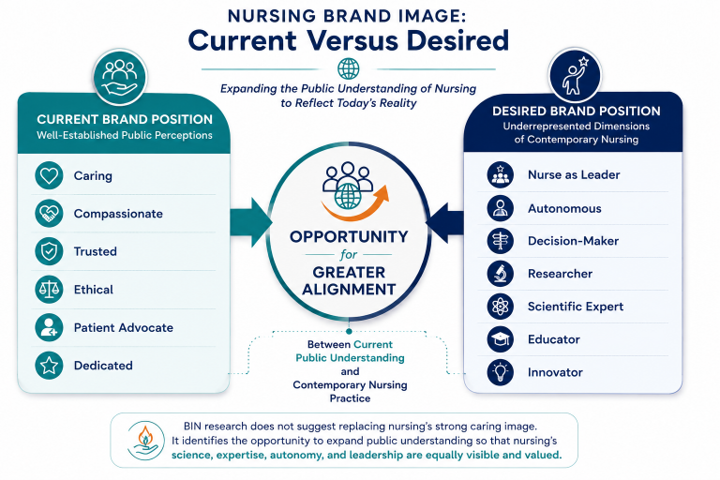
What the evidence shows.
The gap is consistent
Across clinical settings, roles, and countries, nurses perceive a meaningful distance between current and desired brand position.
Nurses see more than the public sees
The profession’s scientific, autonomous scope is consistently under-recognized in public perception.
Desired position centers on autonomy
The brand nurses want is defined by expertise, leadership, and independence—not by tasks or sacrifice.
Measurement enables change
Quantifying the gap turns an abstract image problem into an evidence-based target for intentional action.
An image problem becomes an evidence problem.
For decades, nursing’s public image was treated as a cultural given—shaped by media, history, and assumption, and largely beyond the profession’s control. BIN research changes that premise.
By measuring both where nursing stands and where nurses believe it should stand, the instruments turn a diffuse image problem into a defined, trackable gap. That gap can be studied across cultures, monitored over time, and addressed through evidence-based strategy—in education, leadership development, and public communication.
The finding is not that nursing is misunderstood. It is that the distance between perception and practice is measurable, consistent, and—measured—finally manageable.
Read the studies behind the gap.
The peer-reviewed publications detail the instruments, the samples, and the cross-cultural findings.